
Budgets Get Cut. Building Maintenance Doesn't.
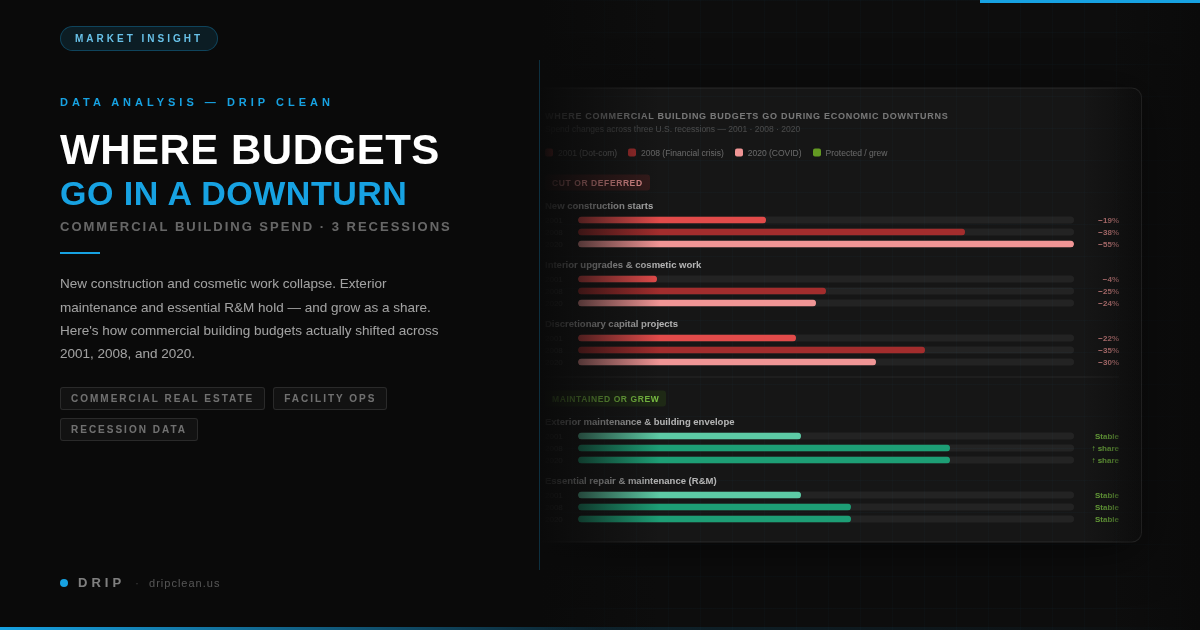
Across 2001, 2008, and 2020, commercial building budgets followed the same pattern — new construction stalled, cosmetic work stopped, discretionary projects were pushed. But exterior maintenance held. In some cycles it grew. Here's why facility managers keep protecting it even when everything else gets cut.
Every time the economy tightens, facility managers face the same pressure: find something to cut. Exterior cleaning looks like an easy target. It's not structural, it's not an emergency, it can wait.
Three recessions say otherwise.
The pattern is consistent
Across 2001, 2008, and 2020, the same thing happened every time. New construction stalled. Interior upgrades were paused. Discretionary capital projects got pushed. But exterior maintenance and essential repair held — and in some cycles, grew as a share of total spend as everything else collapsed around it.
The chart above shows exactly where the cuts land and what gets protected. It's the same story each time.
Why exterior maintenance doesn't get cut
Because deferring it isn't free. It just moves the cost forward — with interest.
Deferred exterior maintenance compounds at roughly 7% per year. A facade issue left unaddressed doesn't stay small. Deteriorating sealant becomes water infiltration. Water infiltration becomes insulation damage. Insulation damage becomes a structural conversation. By the time it demands attention, the bill can run 10 to 15 times what routine maintenance would have cost.
A routine drone cleaning on a commercial tower in Brooklyn identified failing window sealant before it caused damage. The property manager estimated $120,000 in avoided repairs — caught during what was otherwise a standard service visit.
Post-recession, BOMA data confirmed what facility managers already knew: commercial R&M spending surged 6.2% the year after the Great Recession ended. The spend didn't disappear during the downturn. It compressed, then came back hard.
Where DRIP fits
Tight budgets don't eliminate exterior maintenance — they create pressure to do it smarter. No scaffolding, no sidewalk closures, no week-long mobilization. DRIP's drone-enabled approach handles high-reach facade work in a fraction of the time and cost of traditional methods, with a ground crew handling everything at grade in the same visit.
One engagement. Full building. And because the drones carry cameras, every cleaning also produces a visual inspection — catching the issues that become expensive before they do.
The buildings that come out of downturns in the best shape aren't the ones that went dark on maintenance. They're the ones that kept the envelope clean and caught problems early.
The $50B Problem Behind the Push to Make Federal Buildings Beautiful Again
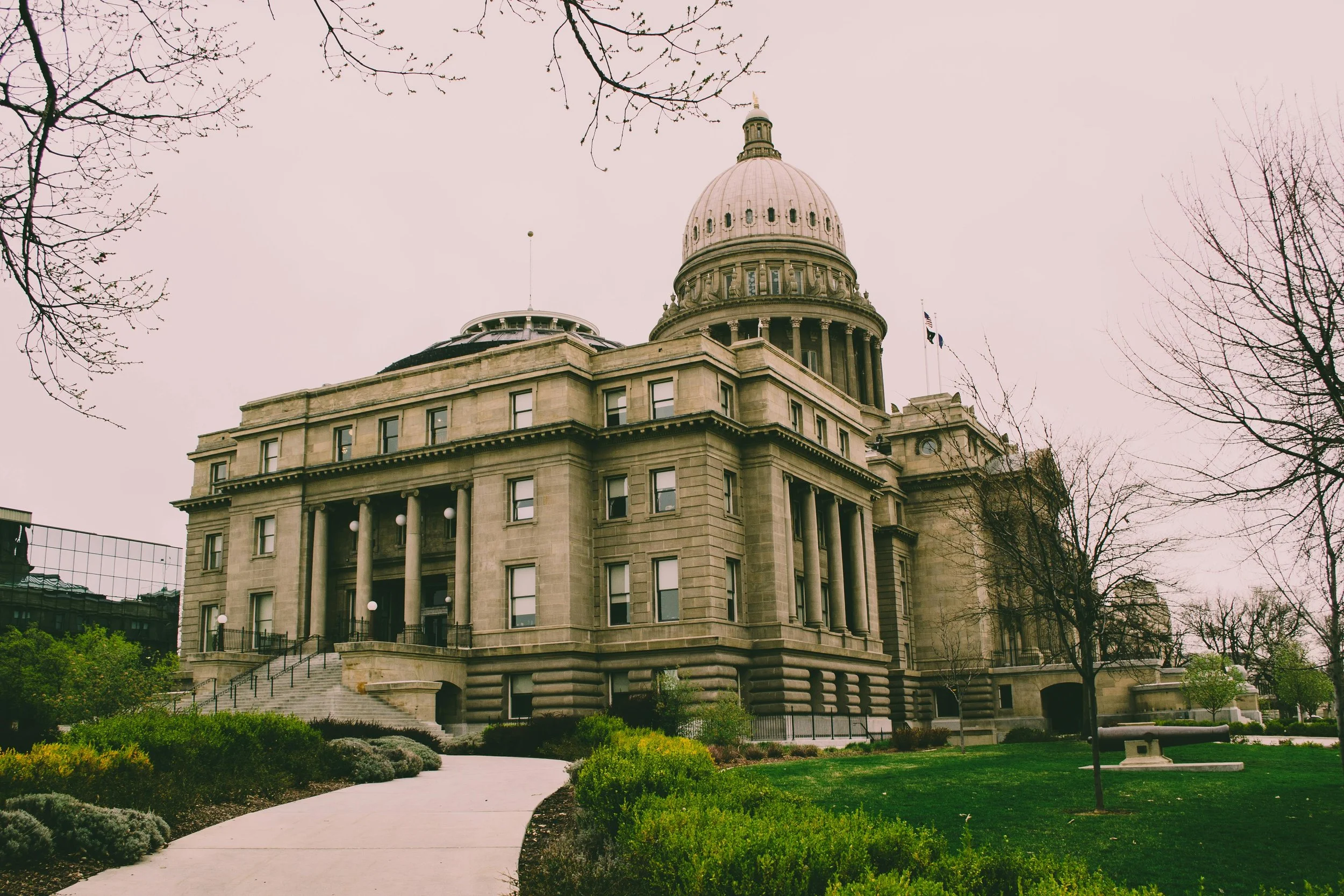
There's a $50B maintenance backlog for government buildings — growing ~25% y/y — and a national push to make them beautiful, again.
But you can't build beautiful on top of decades of neglect.
Government facilities get as low as a tenth of the maintenance budget the private sector considers the bare minimum. The costs compound. Older buildings eat the budget. Newer builds start on the wrong foot. And at some point, demolition becomes the cheapest route.
Exterior maintenance is the lowest-cost way to impede that cycle — and the first thing that gets deferred.
The $50B Problem Behind the Push to Make Federal Buildings Beautiful Again
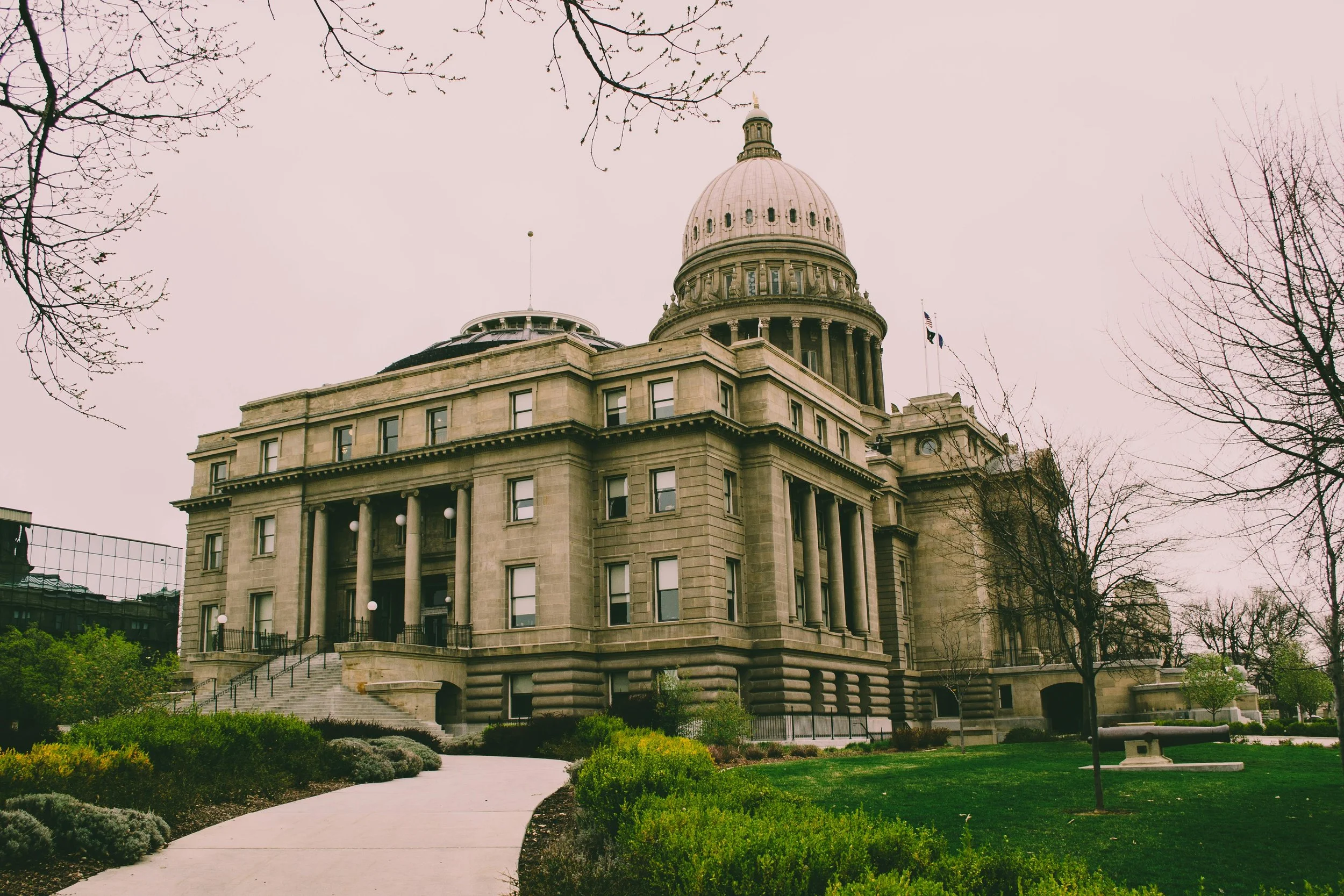
There's a $50B maintenance backlog for government buildings — growing ~25% y/y — and a national push to make federal buildings beautiful, again. That push includes both new construction and renovation, with advisory for classical architecture moving forward. Think limestone facades and Beaux-Arts detailing.
But first, you can't build beautiful on top of decades of neglect and deferral. Government facilities get as low as a tenth of the maintenance budget the private sector considers the bare minimum. As this backlog compounds — minor repairs are deferred to the point of major renovation. Older buildings (30+ years old) are consuming a disproportionate amount of the resources — forcing newer builds to start off on the wrong foot to maintain cost-effectiveness and operations. The cycle starts to appear. Then, there's a point where demolition becomes the cheapest route — with another subset of aging buildings added to limbo.
Exterior maintenance is the lowest-cost way to impede the cycle, but the first thing that gets deferred. Dirt, biological growth, and pollutants break down coatings, accelerate material degradation, and drive up cooling costs. The reason it keeps getting pushed? Traditional exterior methods require scaffolding, boom lifts, lane closures, and multi-day mobilization — the kind of scope and cost that makes it easy for a stretched facility manager to say "next year." And next year turns into five.
Good news is technology and other operational efforts are bridging that gap — making routine maintenance more accessible, repeatable within annual work orders. Allows the opportunity to achieve more progress within a lower cost basis.
At DRIP, we use drone technology to deliver commercial exterior cleaning — faster mobilization, smaller crews, documented results. The kind of service that fits inside an annual maintenance budget, not a capital project. For government facilities trying to chip away at decades of deferral, that difference matters. More buildings serviced per dollar. More progress per year.
Imagine if even a fraction of that $50B backlog could be addressed by shifting exterior maintenance from a deferred line item to a recurring, low-cost work order. Buildings preserved instead of demolished. Newer facilities freed up to operate the way they were designed to. The cycle doesn't just slow down — it starts to reverse.
That's the work worth doing.
👉 Learn more at dripclean.us | Request a free site assessment
The Hidden Energy Cost of Dirty Buildings
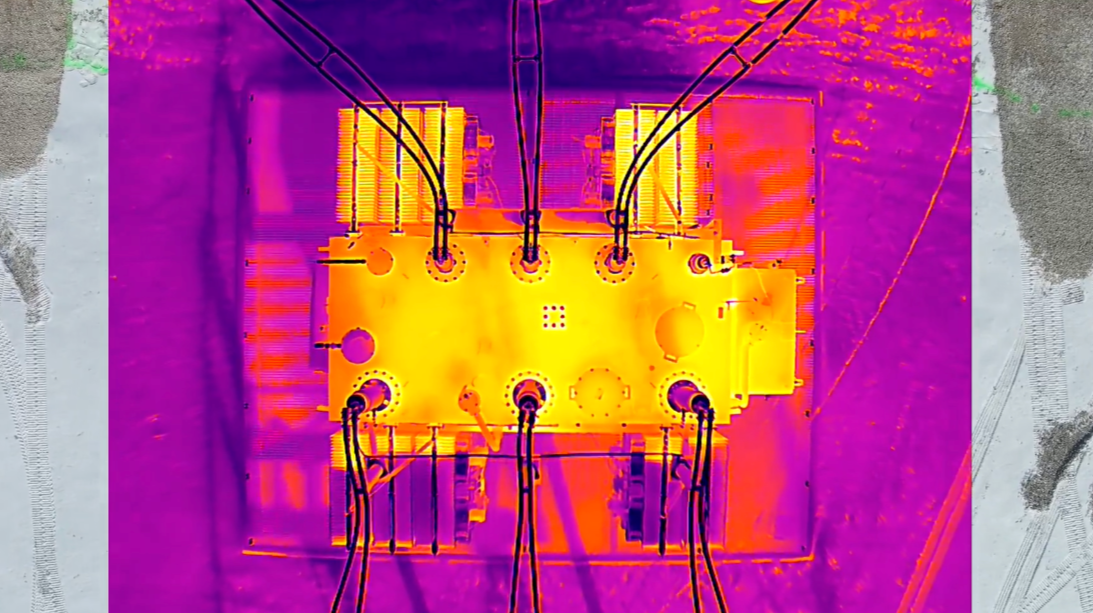
Energy efficiency upgrades are only as strong as the building envelope that supports them. Research confirms that reflectivity degradation reduces cooling savings year over year — yet ongoing maintenance is rarely addressed. This article examines the data, the cost implications, and how drone-based exterior programs make reflectivity protection viable at scale.
How Routine Maintenance Protects Energy Performance Through Reflectivity
DRIP Clean | A Service of VizionAir
Every year, facility managers invest heavily in energy efficiency upgrades — HVAC replacements, LED retrofits, smart controls, insulation improvements. These projects are designed to reduce operating costs and extend building system life. But there is a silent factor undermining those savings that rarely makes it into the maintenance plan: the gradual loss of building envelope reflectivity.
Roofs and exterior surfaces accumulate dirt, biological growth, soot, and atmospheric pollutants from the moment they are installed. On reflective or “cool” roofing systems — now standard on most commercial and institutional buildings — this soiling directly reduces the roof’s ability to reflect solar energy. The result is higher surface temperatures, greater heat transfer into the building, increased cooling loads, and rising utility costs.
The question is not whether this degradation happens. The research is clear that it does. The question is what to do about it — and whether new technology has finally made routine reflectivity maintenance practical and cost-effective.
What the Research Says
The most authoritative body of research on this topic comes from Lawrence Berkeley National Laboratory (LBNL), which has studied reflective roofing performance for over two decades.
Their findings paint a consistent picture. Most reflectivity loss occurs within the first year of a roof’s life, with an average albedo decrease of 0.15 on a 0–1 scale. Roughly 70% of that first-year drop happens within the first two months. After year one, degradation slows but continues — and LBNL estimated that this weathering results in approximately a 20% reduction from first-year cooling energy savings for every subsequent year.
To put that in perspective: if a cool roof saved a building $10,000 in cooling costs during its first year, that building is losing roughly $2,000 per year in unrealized savings from reflectivity degradation alone — and that loss compounds across every building in a portfolio.
A 2025 study published in Frontiers in Sustainable Cities reinforced these findings, examining cool roof albedo trends across New York City from 2014 to 2020. The researchers confirmed that reflectivity degrades in a geographically patterned and time-dependent manner. Perhaps most notably, they found that while NYC building codes require roof surfaces to meet cool roof standards at installation, there is no mandate for ongoing albedo maintenance — a gap that raises serious questions about whether these energy investments are being protected over time.
The Savings at Stake
The energy impact of reflectivity is well-documented across multiple federal and academic sources:
The U.S. Department of Energy reports that conventional roofs can reach 150°F or more on a sunny afternoon, while reflective roofs under the same conditions stay more than 50°F cooler. The EPA notes that cool roof reflectance can reduce peak cooling demand by 11–27% in air-conditioned buildings.
A 2021 study in Energies found that for low-rise offices and schools, reflective roofs deliver clear energy benefits across all U.S. climate zones, with savings averaging $0.356 per square meter of roof area nationwide. For a 10,000-square-foot school roof, that translates to roughly $330 in annual savings — per building — that is at risk when reflectivity degrades.
Field research by the Florida Solar Energy Center measured even more dramatic results: air conditioning reductions of 10–43% after applying reflective coatings, with an average of 19% savings and peak demand reductions of 22%.
The Good News: Cleaning Works
Here is where it gets encouraging. LBNL’s studies found that washing reflective roof coatings restored 90–100% of the initial albedo. A separate study of 15 single-ply membranes showed that even heavily soiled roofs — with albedo ratios as low as 0.41 of original values — could be restored to near-original performance through progressive cleaning.
The reflectivity loss is not permanent damage. It is accumulated soiling that can be reversed. The roof does not need to be replaced or recoated — it needs to be cleaned.
Why It Is Not Happening: The Traditional Maintenance Problem
If the science is this clear, why are so few facility managers running reflectivity maintenance programs?
The answer comes down to the economics and logistics of traditional cleaning methods. Commercial roof and exterior cleaning has historically required pressure washing crews, scaffolding or aerial lift rentals, and manual soft-wash application using ladders and harnesses. These methods work — but they come with friction that makes routine scheduling impractical.
Cost is the biggest barrier. Scaffolding and lift rentals often represent a larger share of the project cost than the cleaning itself. For multi-story buildings or campus environments, mobilization costs alone can exceed the energy savings that cleaning would restore.
Safety is a close second. Falls from height remain one of the leading causes of workplace fatalities in the U.S. Every crew member on a ladder or roof represents liability exposure — and that risk is a primary reason facility managers defer maintenance.
Disruption compounds the problem. Traditional cleaning requires lane closures, restricted access, tenant notifications, and significant setup time. For occupied buildings like schools, courthouses, and senior centers, this is a real scheduling barrier.
Time and inconsistency round out the challenge. Large roofs take days to clean manually, and coverage from lifts or ladders can be uneven — missed spots, streaking, and repositioning gaps are common.
LBNL acknowledged this reality directly in their original research: while washing is effective at restoring albedo, the cost of hiring someone to clean a roof solely for energy savings was not justified under traditional methods.
That conclusion, however, was based on the cost structure of traditional cleaning. It did not account for a fundamentally different way to deliver the service.
How Drones Change the Equation
Commercial cleaning drones — UAVs equipped with soft-wash spray systems, precision nozzles, and biodegradable cleaning solutions — are now operating across the United States. Flown by FAA Part 107 certified pilots, these systems clean roofs, facades, windows, and solar panels from a controlled distance, without putting anyone on the roof or requiring scaffolding, lifts, or ladder access.
The barriers that made reflectivity maintenance impractical are precisely the barriers drones eliminate.
Cost drops significantly. Industry data suggests traditional exterior cleaning costs 25–50% more per square foot than drone-based services. By removing scaffolding, lifts, and large crew requirements, drones push the cost of cleaning below the threshold where it is justified by restored energy savings — making routine maintenance economically viable for the first time.
Safety risk is effectively eliminated. No workers on roofs, no ladders, no fall exposure. This removes one of the primary reasons maintenance gets deferred.
Disruption is minimal. Drone operations require a small ground footprint, produce less noise than heavy equipment, and do not require building closures or tenant displacement. Schools and government buildings can be serviced during normal operations.
Speed enables portfolio-scale programs. What takes a traditional crew days can often be completed in hours with drones. This makes it practical to maintain dozens of buildings on a recurring schedule rather than treating each as a standalone project.
Every visit doubles as an inspection. Most cleaning drones carry high-resolution cameras that capture before-and-after imagery and roof condition data. This turns every maintenance cycle into a documented assessment — providing facility managers with actionable data on drainage issues, membrane condition, and debris accumulation that feeds directly into capital planning.
What This Looks Like in Practice
A recurring drone-based reflectivity maintenance program follows a structured cadence. It begins with a baseline drone survey that captures the current condition of roof and facade surfaces. An initial soft-wash treatment restores reflectivity toward original values. From there, a recurring schedule — typically semi-annual or annual, depending on climate and exposure — prevents the degradation curve from compounding. Each visit produces condition documentation that tracks performance over time and flags issues early.
For organizations managing multiple buildings — counties, school districts, property management firms — this model scales efficiently. A single mobilization can service an entire campus or portfolio in a fraction of the time traditional methods would require.
This is not a one-time cleaning job. It is a maintenance program, designed to protect long-term energy performance the same way a filter change or coil cleaning protects mechanical system efficiency.
DRIP Clean: Built for This Moment
DRIP Clean, a service line of VizionAir, is a drone-powered commercial exterior cleaning service built around the recurring maintenance program model. Rather than one-time reactive cleaning, DRIP partners with facility managers, property management companies, and municipal clients to deliver structured programs that protect building performance and reduce long-term operating costs.
What sets DRIP apart starts with its philosophy: programs, not one-time jobs. Every engagement is designed around a recurring cadence tailored to the facility’s needs, ensuring reflectivity degradation, biological growth, and soiling are addressed proactively rather than reactively.
DRIP is drone-first by design, delivering the safety, speed, cost, and consistency advantages that make routine exterior maintenance viable at scale. But the company does not stop at cleaning. DRIP is built on a foundation of technology-enabled service delivery — visual documentation with every visit, before-and-after imaging for compliance reporting, portfolio-level service coordination, and integration with broader energy performance goals.
For clients operating under Guaranteed Energy Savings Projects or similar performance contracts, DRIP’s programs provide an additional layer of protection for contracted savings by maintaining the building envelope conditions those savings depend on. It is a natural complement to the HVAC, lighting, and controls upgrades that energy service companies deliver — filling a gap that most traditional maintenance providers cannot address cost-effectively.
The Bottom Line
The research is settled: building reflectivity degrades, the energy cost is real, and cleaning restores it. The historical barrier — that traditional cleaning costs exceeded the energy benefit — no longer holds when drones fundamentally change the cost structure.
For facility managers, property owners, and municipal leaders who have invested in energy efficiency, the question is no longer whether reflectivity matters. It is whether your maintenance program is designed to protect that investment over time.
DRIP Clean is a service of VizionAir. To learn more about recurring exterior maintenance programs powered by drone technology, reach out to discuss your facility’s needs.
SourcesLawrence Berkeley National Laboratory (Bretz & Akbari, 1997) • Frontiers in Sustainable Cities (2025) • U.S. Department of Energy • U.S. Environmental Protection Agency • Energies/MDPI (Tzempelikos & Lee, 2021) • Florida Solar Energy Center (FSEC-PF-293-95)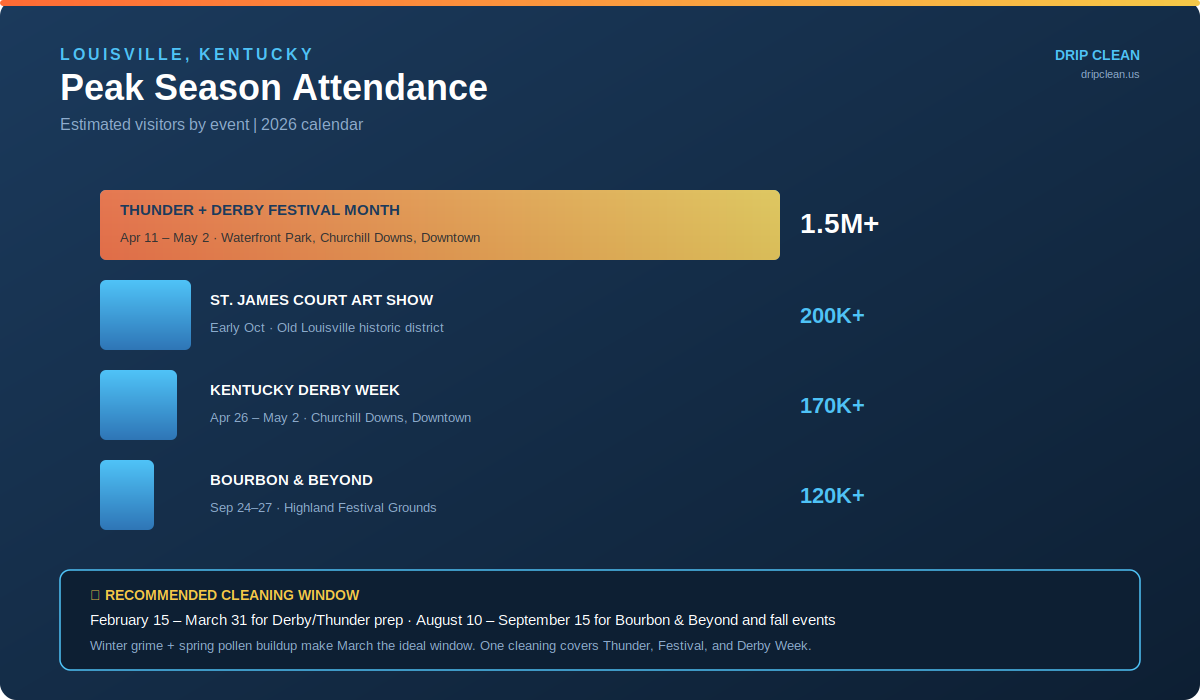
Peak Season Is Coming: Why Building Exteriors Can’t Wait
From Derby to Indy 500 to BLINK, millions of visitors are coming. Here’s how facility managers are preparing building exteriors ahead of peak season.
How Facility Managers Across Kentucky, Indiana, and Ohio Are Preparing for the Busiest Tourist Seasons of 2026
Between April and October, the cities of Louisville, Indianapolis, Cincinnati, and Lexington will collectively welcome more than ten million visitors across dozens of major events. From the Kentucky Derby to the Breeders’ Cup, the Indianapolis 500 to the Final Four, Oktoberfest Zinzinnati to BLINK — these events don’t just fill hotel rooms and restaurant seats. They put every building, parking garage, and commercial facade in the region on full display.
For facility managers and property managers, that means one thing: the condition of your building’s exterior is no longer just a maintenance line item. It’s a first impression for hundreds of thousands of visitors, a reflection of your brand, and in many cases, a factor in tenant retention and lease rates.
The question isn’t whether your building will be seen. It’s whether it’ll be ready.
The Busiest Months Are Closer Than You Think
The event calendar across these four metro areas is stacked. Here’s what’s coming:
Louisville kicks off with Thunder Over Louisville on April 18 — the largest annual fireworks display in North America — followed immediately by two weeks of Kentucky Derby Festival events leading to Derby Day on May 2. That single month will bring an estimated 1.5 million visitors to the downtown corridor, Waterfront Park, and surrounding neighborhoods. Later in the year, Bourbon & Beyond (September 24–27) draws over 100,000 to the Highland Festival Grounds, and the St. James Court Art Show in early October puts 200,000 pairs of eyes on Old Louisville’s historic architecture.
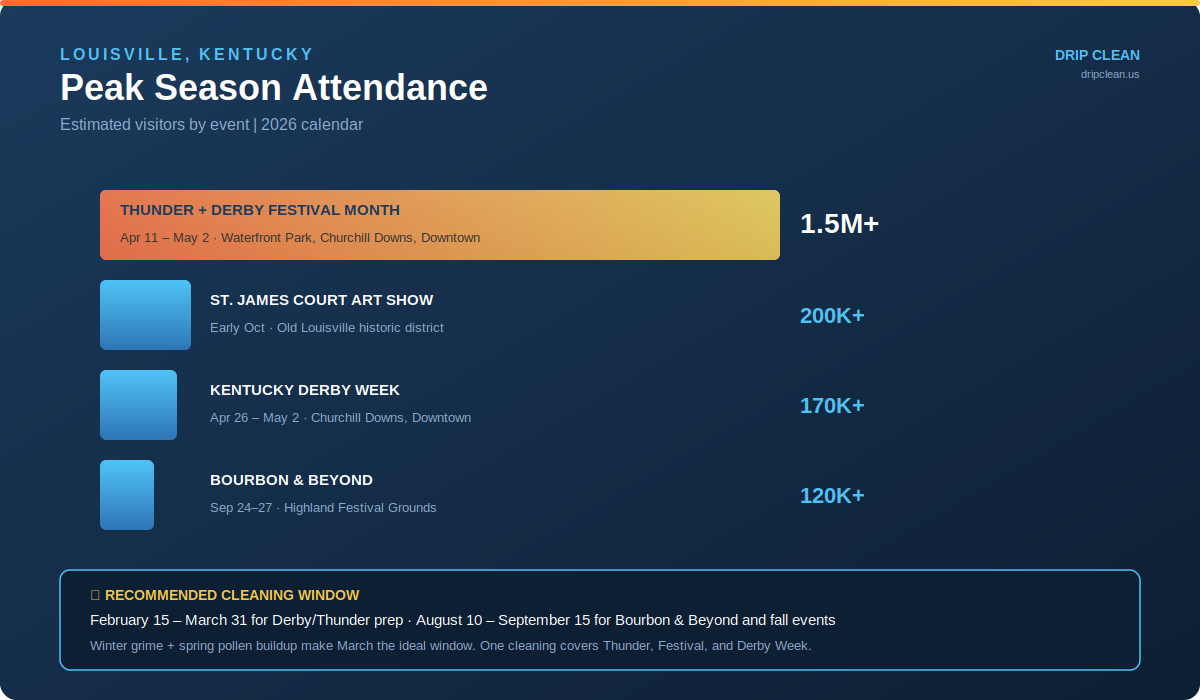
Louisville peak season attendance by event | 2026
Indianapolis hosts the NCAA Men’s Final Four at Lucas Oil Stadium from April 3–6, drawing 100,000 visitors and national television coverage to the downtown core. Then comes the Month of May — and it’s not just race day. Practice opens at the Indianapolis Motor Speedway in mid-May, followed by two qualifying weekends, the Carb Day concert, Legends Day, the 500 Festival Parade through downtown, and finally the race itself on May 24 with more than 300,000 fans. All told, the Month of May brings an estimated 600,000 visitors to central Indiana over three-plus consecutive weeks. Gen Con fills 70,000 hotel rooms at the end of July, and the Indiana State Fair runs 17 days in August with over 900,000 attendees.

Indianapolis peak season attendance by event | 2026
Cincinnati sees Taste of Cincinnati draw 500,000 over Memorial Day weekend, followed by the Cincinnati Music Festival in late July. But the real crescendo comes in September and October: Oktoberfest Zinzinnati celebrates its 50th anniversary September 17–20 with an expected 800,000 attendees, and just three weeks later, BLINK — the nation’s largest light art and projection mapping festival — transforms 30 city blocks into an outdoor art gallery for more than two million visitors.
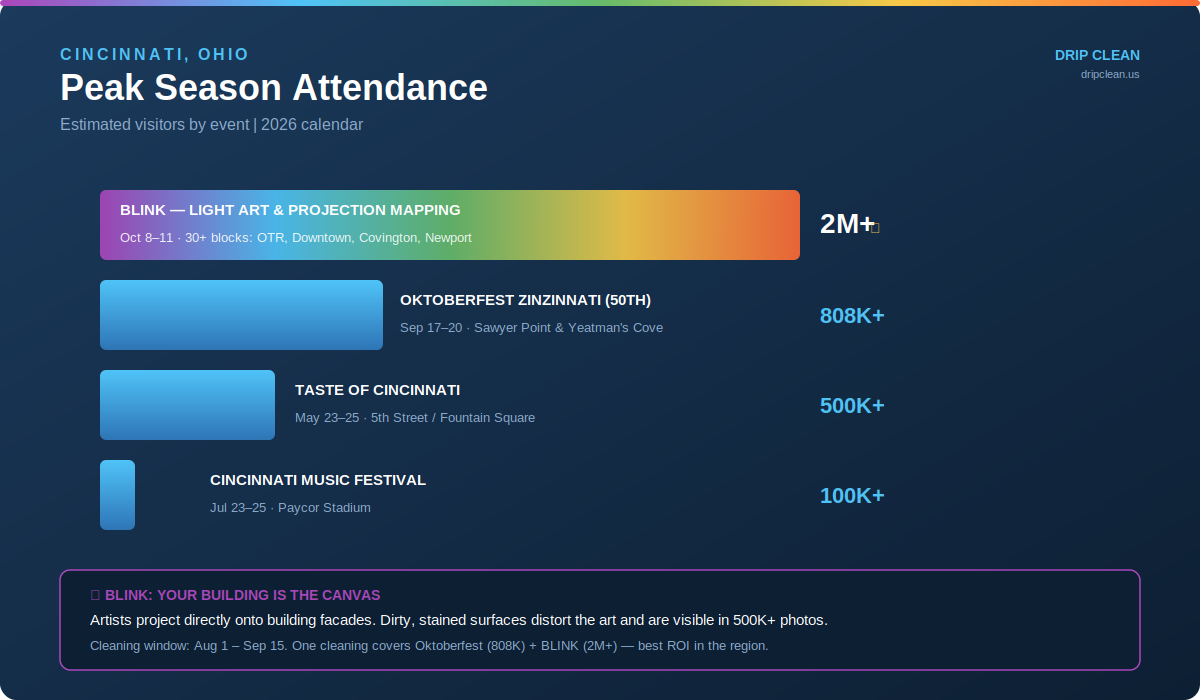
Cincinnati peak season attendance by event | 2026
Lexington opens Keeneland’s Spring Meet on April 3, debuting a brand-new $100 million Paddock Building alongside 15 days of premier thoroughbred racing. The Railbird Music Festival brings 40,000 fans to Red Mile in June, UK Football’s SEC schedule fills 61,000-seat Kroger Field every Saturday in the fall, and the Breeders’ Cup World Championships return to Keeneland October 30–31 with international media and horse racing’s most prestigious visitors.

Lexington peak season attendance by event | 2026
The Facility Manager’s Responsibility
Every one of these events creates a concentrated surge of foot traffic, photography, social media exposure, and in the case of BLINK, literal projections onto building facades. For facility managers, the stakes are straightforward but significant.
A building’s exterior is the first thing visitors, tenants, and prospective clients see. Algae streaks on a hotel facade during Derby Week don’t just look bad — they show up in guest photos, Google reviews, and social media posts seen by thousands. Pollen-covered limestone on a downtown office building during Final Four weekend signals neglect to every corporate tenant walking through the lobby. A parking garage with years of grime buildup across from the Oktoberfest grounds tells 800,000 people that nobody’s paying attention.
Building exteriors deteriorate predictably with the seasons. Winter leaves behind road salt residue and grime. Spring coats light-colored stone and concrete in pollen. Summer’s heat and humidity accelerate algae and mold growth on north-facing walls. Fall brings leaf staining and organic debris. Each season layers on the last, and by the time a major event arrives, the cumulative effect is visible from the street.
The responsibility falls to facility managers and property managers to plan ahead — not just for the event itself, but for the seasonal maintenance window that precedes it. A building cleaned six to eight weeks before a major event will look fresh through the entire peak season. A building cleaned the week before will still be drying when the first visitors arrive.
A Better Approach for Buildings That Can’t Afford Downtime
The challenge with traditional exterior cleaning has always been logistics. Scaffolding takes days to erect and requires permits, lane closures, and coordination with tenants. Boom lifts block parking lots and sidewalks. Swing stages limit cleaning to one wall section at a time. For a hotel at 95% occupancy during Derby Week or a convention center hosting 70,000 attendees, shutting down access to erect scaffolding simply isn’t an option.
This is where drone-powered exterior cleaning is changing the conversation for commercial and industrial properties.
Purpose-built cleaning drones operate from ground level with no scaffolding, no lifts, and no disruption to building access or daily operations. A drone can clean building exteriors up to 150 feet — or higher — reaching facades, soffits, signage, and upper-story windows that traditional methods struggle to access efficiently. Because the equipment launches and operates from the ground, there are no lane closures, no parking lot shutdowns, and no tenant complaints about blocked entrances or equipment noise.
The operational benefits for facility managers are measurable. Project timelines compress by 40 to 60 percent compared to traditional scaffolding-based approaches. Setup time drops from days to hours. Safety risk is dramatically reduced because workers stay at ground level rather than operating at height. And because the drone can access the full building envelope in a single mobilization, you get comprehensive coverage rather than the piecemeal, section-by-section approach that scaffolding forces.
For properties in high-traffic event zones — a downtown hotel on Louisville’s Whiskey Row, an office tower on Indianapolis’s Capitol Avenue, a mixed-use building on Cincinnati’s Vine Street, or a parking garage on Lexington’s Versailles Road — the ability to clean quickly, safely, and without operational disruption isn’t just a convenience. It’s the only practical option during peak season.
A Special Note for Cincinnati Building Owners: BLINK 2026
BLINK deserves its own mention because it flips the script entirely. During most events, buildings are the backdrop. During BLINK, buildings are the canvas. Artists project large-scale light installations directly onto building facades across 30 blocks of downtown Cincinnati, Over-the-Rhine, and Northern Kentucky. If a facade is stained, streaked, or discolored, it doesn’t just look bad — it distorts the art. Building owners in the BLINK corridor have a direct incentive to ensure their exteriors are clean, even, and projection-ready. The cleaning window between Oktoberfest (September 17–20) and BLINK (October 8–11) is tight, which makes planning ahead essential.
Plan Now, Not Later
The events on the 2026 calendar are already set. The dates are locked. The visitors are coming. The only variable is whether your building will be ready for them.
The most effective facility managers are the ones who plan exterior maintenance around their market’s event calendar rather than reacting to it. That means identifying your cleaning window — typically six to eight weeks before a major event — and scheduling work before demand peaks and vendor availability tightens.
For Louisville properties, that window is February through March. For Indianapolis, it’s March through April. For Cincinnati, it’s August through mid-September. For Lexington, the spring window opens in February, and the fall window runs through September and early October.
The buildings that look their best during peak season aren’t the ones with the biggest maintenance budgets. They’re the ones with the best planning. Start the conversation with your cleaning partners now, lock in your dates, and make sure your property is ready for its moment in the spotlight.
DRIP Clean LLC specializes in drone-powered exterior cleaning for commercial and industrial buildings across Kentucky, Indiana, Ohio, and Tennessee. To schedule a free site assessment or learn how drone cleaning can fit your maintenance calendar, visit www.dripclean.us or call 317.522.6226.
How Drone Technology is Taking Over Commercial Power Washing
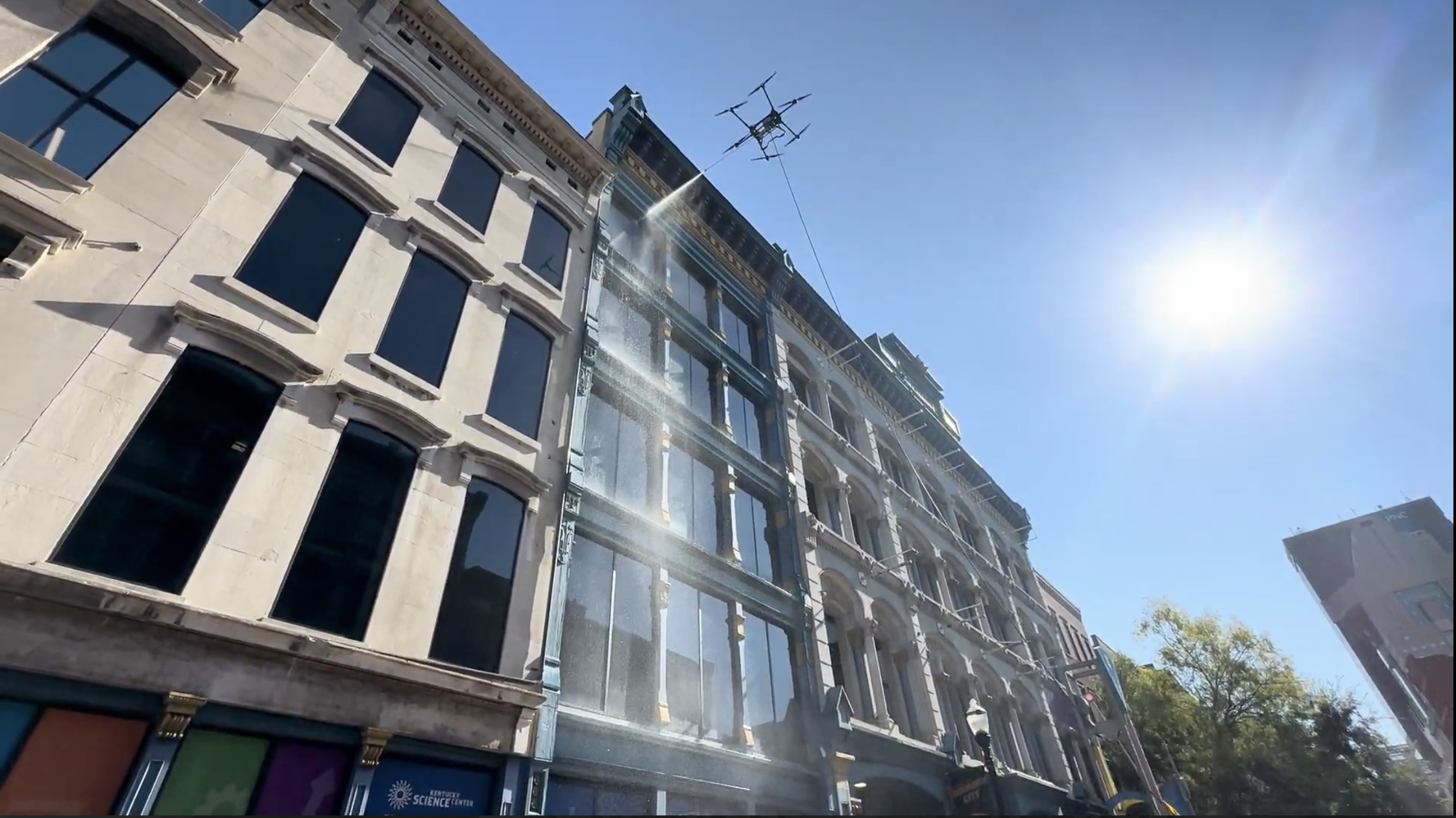
Drone technology has changed exterior cleaning for buildings and infrastructure. Equipped with precision nozzles and cleaning tools, drones can tackle dirt, stains, and even hazardous materials with efficiency and safety. This method eliminates the need for scaffolding or heavy equipment, making it an effective choice for modern cleaning demands.
What is Drone Exterior Cleaning?
Drone exterior cleaning uses unmanned aerial vehicles (UAVs) to clean building exteriors, bridges, industrial structures, and more. These drones are equipped with high-pressure water systems or chemical sprayers to remove dirt, grime, and stains from hard-to-reach surfaces. In addition to high-pressure cleaning, drones can also perform soft washing, which uses low-pressure water and eco-friendly cleaning solutions to safely clean delicate surfaces like siding, roofs, and windows.
Controlled remotely by skilled operators, drones provide a safe and cost-effective solution for exterior maintenance while offering versatility to address a wide range of cleaning needs.
Key Benefits of Drone Exterior Cleaning?
1. Safety
Drones remove the need for workers to operate at dangerous heights or in hazardous environments. By keeping operators safely on the ground, drones reduce the risk of falls, injuries, and liability for companies.
2. Efficiency
Drones clean large surfaces and complex architectural designs faster than traditional methods. This reduces downtime for businesses and allows projects to be completed more quickly.
3. Accessibility
Drones can reach hard-to-access areas that are difficult to clean using traditional methods. From tall building facades to intricate structural designs, drones clean these areas without scaffolding or extensive equipment.
4. Cost-Effectiveness
Traditional exterior cleaning methods often involve large teams, extensive equipment, and significant setup times, which all increase costs. Drones simplify the process by reducing labor needs, eliminating scaffolding, and speeding up cleaning times. This streamlined approach not only saves money but also ensures minimal disruption to operations.
Overall Cost Difference: Drone Cleaning vs. Traditional Methods
Traditional cleaning methods often come with substantial costs due to the complexity of setup, labor requirements, and equipment needs. These factors can quickly drive up expenses, especially for high-rise buildings or large-scale infrastructure.
In contrast, drone cleaning streamlines the entire process, eliminating many of the inefficiencies of traditional methods. By requiring fewer workers, avoiding costly scaffolding and lift rentals, and significantly reducing cleaning times, drone cleaning services can save businesses 25% to 35% per project.
For example, while traditional cleaning for a mid-rise commercial building might cost $10,000 due to equipment and labor, drone cleaning could achieve the same results for $7,500 or less. This significant difference makes drone technology not only a safer but also a more economical choice for exterior cleaning.
Cost Breakdown: Why Drone Cleaning is 25-35% Cheaper
1. Reduced Labor Costs
Drone cleaning requires fewer personnel compared to traditional methods. A skilled drone pilot and a ground technician can handle the job, eliminating the need for large teams and lowering labor expenses.
2. Minimal Setup Time
Traditional methods involve time-consuming setup for scaffolding, lifts, or swing stages. Drones operate immediately upon arrival, saving both time and money.
3. Faster Project Completion
Drones clean large areas quickly, significantly reducing the overall project timeline. This minimizes downtime for businesses and lowers total costs.
4. Lower Equipment Costs
Traditional methods rely on expensive equipment rentals like scaffolding and lifts. Drones eliminate these costs, providing a more cost-effective solution.
Case Studies and Examples
Example 1: Cleaning the Facade of a Commercial Building
A mid-rise commercial building with intricate architectural details required exterior cleaning to remove years of grime. Traditional methods would involve scaffolding and several days of work. Drone cleaning reduced costs by 30% and completed the project in half the time.
Example 2: Bridge Maintenance Using Drones
A steel bridge needed routine cleaning to prevent corrosion and maintain structural integrity. Traditional cleaning would require specialized equipment and worker safety measures. Drones reduced costs by 40%, eliminating safety concerns while efficiently cleaning hard-to-reach areas.
Example 3: Stadium Cleaning Made Easy
A sports stadium required exterior cleaning before its seasonal opening. Traditional methods would take weeks to complete and come with a high price tag. With drones, the same task was completed in just days, reducing costs by 35% and ensuring the stadium opened on schedule.
Comparative Analysis: Cost and Liability
Drone Cleaning: Lower Risk, Lower Costs
Lower Labor Costs: Fewer personnel required for operation.
Insurance Savings: Reduced liability and safety risks result in lower premiums.
Time Savings: Faster project completion minimizes operational disruptions.
Traditional Methods: High Risk, High Costs
High Labor Costs: Large crews and extensive safety measures drive up costs.
Equipment Overhead: Scaffolding, swing stages, and machinery increase expenses.
Operational Downtime: Longer cleaning durations can disrupt business operations, adding hidden costs.
Conclusion: Redefining Exterior Cleaning with Drones
Drone technology is transforming the exterior cleaning industry by offering advantages in safety, efficiency, accessibility, and cost-effectiveness. As buildings and infrastructure become more complex, the demand for drone-powered cleaning solutions continues to grow.
With their ability to handle challenging cleaning projects faster and at a lower cost than traditional methods, drones are setting a new standard for exterior maintenance. This innovative approach ensures that buildings and infrastructure remain clean, well-maintained, and visually appealing for years to come.

At Drip Clean, we specialize in delivering cutting-edge drone cleaning services tailored to your building’s needs. Whether you’re looking to maintain the exterior of a commercial property, industrial structure, or residential complex, our experienced team and advanced drone technology ensure top-quality results at competitive prices.
How Much Does Drone Window Washing Cost?
DRIP | Drone Powered Cleaning Solutions
Drone Window Cleaning
The Evolution of Window Cleaning: From Ladders to Drone Technology
Manual Window Cleaning: The Traditional Approach: In the early days, window cleaning was a manual, labor-intensive task. Workers relied on ladders, squeegees, and buckets of water to clean glass surfaces. While effective for smaller buildings, this method posed significant safety risks for high-rise structures and required extensive physical effort.
Water-Fed Pole Systems: A Game-Changer for Safety and Efficiency: The advent of water-fed poles revolutionized how windows were cleaned. These telescopic poles, equipped with brushes and powered by purified water, eliminated the need for harsh chemicals and detergents. This not only reduced streaks but also allowed cleaners to remain safely on the ground, improving safety and minimizing environmental impact.
Scaffolding and Cradles: Scaling the Heights: As buildings grew taller, scaffolding and window cleaning cradles (often called bosun’s chairs) became essential for mid- and high-rise structures. While these solutions provided access to hard-to-reach areas, they came with logistical challenges and safety risks, making them less than ideal for many projects.
Robotics: Automation in Window Cleaning: The introduction of robotic window cleaners brought automation to the industry. These devices use suction or magnetic mechanisms to cling to glass surfaces and perform basic cleaning tasks. While innovative, robotic cleaners often face limitations with building designs and cannot fully replace human intervention for complex jobs.
The Future: Drone Technology in Window Cleaning: The future of window cleaning services is increasingly pointing towards drone technology. Combining precision, efficiency, and safety, drones are becoming a viable option for high-rise and hard-to-reach areas. As technology advances, drones promise to redefine how buildings are cleaned.
What is Drone Window Washing?
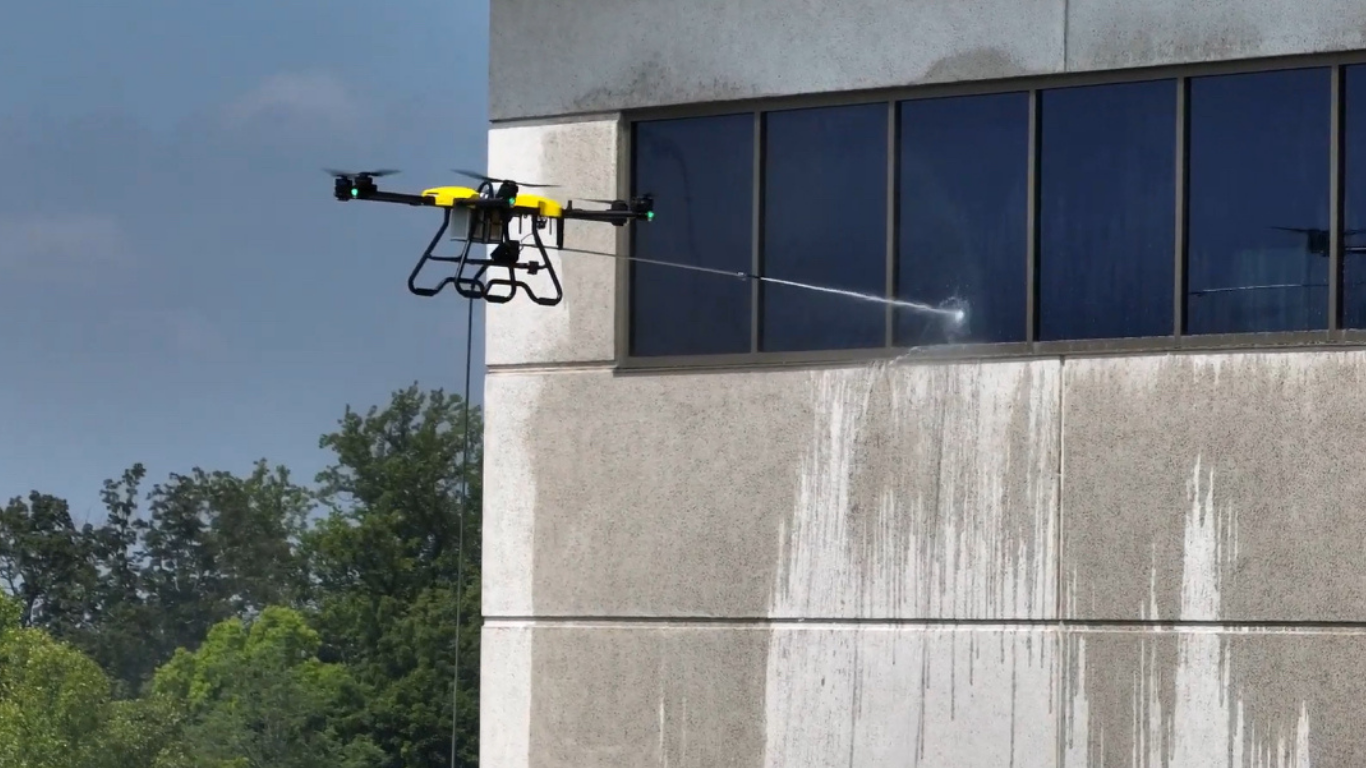
Drone window washing leverages the power of unmanned aerial vehicles (UAVs) equipped with advanced cleaning tools to clean windows on mid- to high-rise buildings or other hard-to-reach structures. These drones are designed to spray cleaning solutions and rinse with deionized water, all remotely controlled by operators on the ground.
Advantages Over Traditional Methods
1. Enhanced Safety
Drones eliminate the need for ladders, scaffolding, or rappelling, significantly reducing the risks associated with human window cleaners working at dangerous heights. This not only enhances worker safety but also lowers liability and insurance costs for companies.
2. Increased Efficiency
Drone technology accelerates the cleaning process, covering large areas in a fraction of the time. With minimal setup and teardown required, studies show that drone window washing can be up to 5 times faster than traditional methods, reducing downtime and increasing productivity.
3. Superior Accessibility
Drones easily access high or hard-to-reach windows, even on buildings with intricate or complex architectural designs. This capability is revolutionizing exterior maintenance for structures previously considered challenging or unsafe for human cleaners.
Average Pricing Overview: Comparing Traditional Methods to Drone Window Washing
The cost of window cleaning varies greatly depending on the method used. Traditional window cleaning typically costs 25% to 50% more per square foot compared to drone cleaning services. This significant price difference stems from the reduced labor and minimized risk factors that drones provide.
However, it’s essential to look beyond just the per-window cost. Drone window washing not only offers a more competitive price but also delivers greater efficiency and accessibility, particularly for cleaning high or hard-to-reach windows. These advantages make drones a cost-effective and practical solution for modern building maintenance.
Case Studies and Examples
Example 1: High-Rise Buildings and Cost-Effectiveness
High-rise buildings showcase the most dramatic cost savings with drones. Traditional methods, such as swing stages or bosun chairs, incur high costs due to height, risk, and time requirements. Drones eliminate much of this risk and operate at either a per-hour rate or fixed project cost, resulting in significant savings. For example, a high-rise with 1,000 panes (standard size - 4x6) might cost around $10,000 using traditional methods, but drone services could reduce this by 25% to 35%, thanks to lower labor and equipment expenses.
Example 2: Cost Breakdown for a Mid-Rise Commercial Building
Mid-rise commercial buildings with extensive glass facades often face elevated costs due to specialized equipment and safety measures. Drones provide a more affordable and time-efficient alternative. For instance, a building with 500 panes (standard size - 4x6) might cost up to $5,000 with traditional methods. Drone services, however, can reduce these costs by 25% to 35%, leveraging their speed and efficiency while mitigating safety risks.
Example 3: Residential Complex Utilizing Drone Services for Annual Cleaning
Residential complexes benefit significantly from drone technology, especially for annual or bi-annual cleaning contracts. In a complex with 200 units, each featuring multiple windows (standard size - 3x4), drones save time and reduce the need for extensive setup, like scaffolding. Traditional cleaning might cost around $5,000, while drones can achieve the same results for 25% to 35% less, with the added bonus of improved safety for complex architectural designs.
Comparative Analysis: Cost of Insurance and Liability in Window Cleaning
Insurance and liability costs vary significantly between drone window cleaning services and traditional window cleaning methods, largely due to differing risk factors and industry regulations. Here’s a breakdown of the key differences.
Drone Operations: Lower Risk, Lower Costs
Insuring drones used for window cleaning typically focuses on:
Property Damage: Covering any unintentional damage caused by the drone.
Accidents Involving the Drone: Protection against equipment failure or unexpected malfunctions.
Liability for Bystanders: Ensuring safety in public or high-traffic areas.
Drone liability insurance generally covers up to $1 million or more, with premiums determined by factors such as:
The drone’s value and specifications.
Frequency of use (flight hours).
The operator’s level of experience and certification.
Since drones are inherently safer than manual cleaning methods, especially for high-rise buildings, insurance premiums are often lower. Reduced risks of falls, injuries, and accidents make drone-based services an attractive and cost-effective option.
Traditional Window Cleaners: Higher Risks, Higher Costs
Traditional window cleaning relies on human workers, which increases risk and liability. Insurance considerations include:
Workers' Compensation: Essential for covering injuries, such as falls or equipment-related accidents, which are common when cleaning at heights.
General Liability: Protecting against property damage and potential injury to others during operations.
Due to the higher likelihood of physical injury, insurance premiums for traditional window cleaning businesses are significantly higher than for drones. These costs can impact overall service pricing, making traditional methods less competitive in certain scenarios.
Conclusion
The evolution of window cleaning methods highlights how technology continues to transform this essential service, making it safer, more efficient, and cost-effective. Drone window washing represents the latest innovation, offering unmatched advantages over traditional methods—particularly in safety, efficiency, and accessibility.
By reducing risks, lowering operational costs, and creating new opportunities in the tech-driven service sector, drones are reshaping the economics and logistics of window cleaning. As high-rise and complex building designs become more common, the demand for drone-powered cleaning solutions is expected to grow, paving the way for a safer, more advanced industry that complements the aesthetics of modern architecture.