
Peak Season Is Coming: Why Building Exteriors Can’t Wait
How Facility Managers Across Kentucky, Indiana, and Ohio Are Preparing for the Busiest Tourist Seasons of 2026
Between April and October, the cities of Louisville, Indianapolis, Cincinnati, and Lexington will collectively welcome more than ten million visitors across dozens of major events. From the Kentucky Derby to the Breeders’ Cup, the Indianapolis 500 to the Final Four, Oktoberfest Zinzinnati to BLINK — these events don’t just fill hotel rooms and restaurant seats. They put every building, parking garage, and commercial facade in the region on full display.
For facility managers and property managers, that means one thing: the condition of your building’s exterior is no longer just a maintenance line item. It’s a first impression for hundreds of thousands of visitors, a reflection of your brand, and in many cases, a factor in tenant retention and lease rates.
The question isn’t whether your building will be seen. It’s whether it’ll be ready.
The Busiest Months Are Closer Than You Think
The event calendar across these four metro areas is stacked. Here’s what’s coming:
Louisville kicks off with Thunder Over Louisville on April 18 — the largest annual fireworks display in North America — followed immediately by two weeks of Kentucky Derby Festival events leading to Derby Day on May 2. That single month will bring an estimated 1.5 million visitors to the downtown corridor, Waterfront Park, and surrounding neighborhoods. Later in the year, Bourbon & Beyond (September 24–27) draws over 100,000 to the Highland Festival Grounds, and the St. James Court Art Show in early October puts 200,000 pairs of eyes on Old Louisville’s historic architecture.
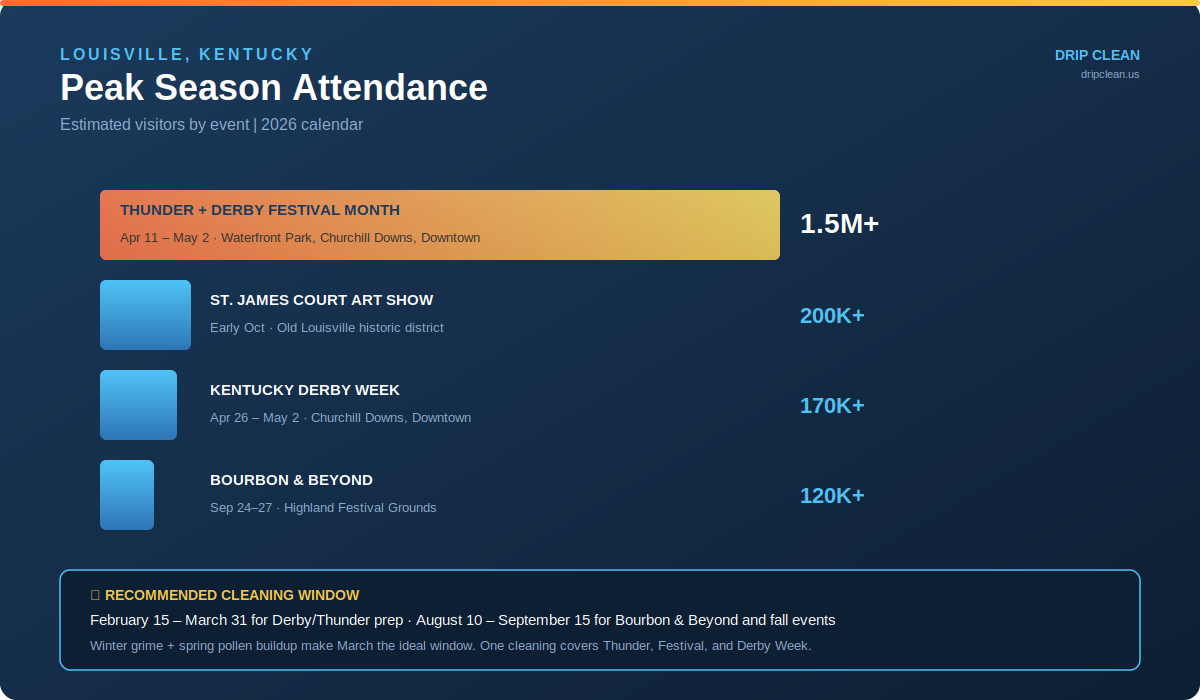
Louisville peak season attendance by event | 2026
Indianapolis hosts the NCAA Men’s Final Four at Lucas Oil Stadium from April 3–6, drawing 100,000 visitors and national television coverage to the downtown core. Then comes the Month of May — and it’s not just race day. Practice opens at the Indianapolis Motor Speedway in mid-May, followed by two qualifying weekends, the Carb Day concert, Legends Day, the 500 Festival Parade through downtown, and finally the race itself on May 24 with more than 300,000 fans. All told, the Month of May brings an estimated 600,000 visitors to central Indiana over three-plus consecutive weeks. Gen Con fills 70,000 hotel rooms at the end of July, and the Indiana State Fair runs 17 days in August with over 900,000 attendees.
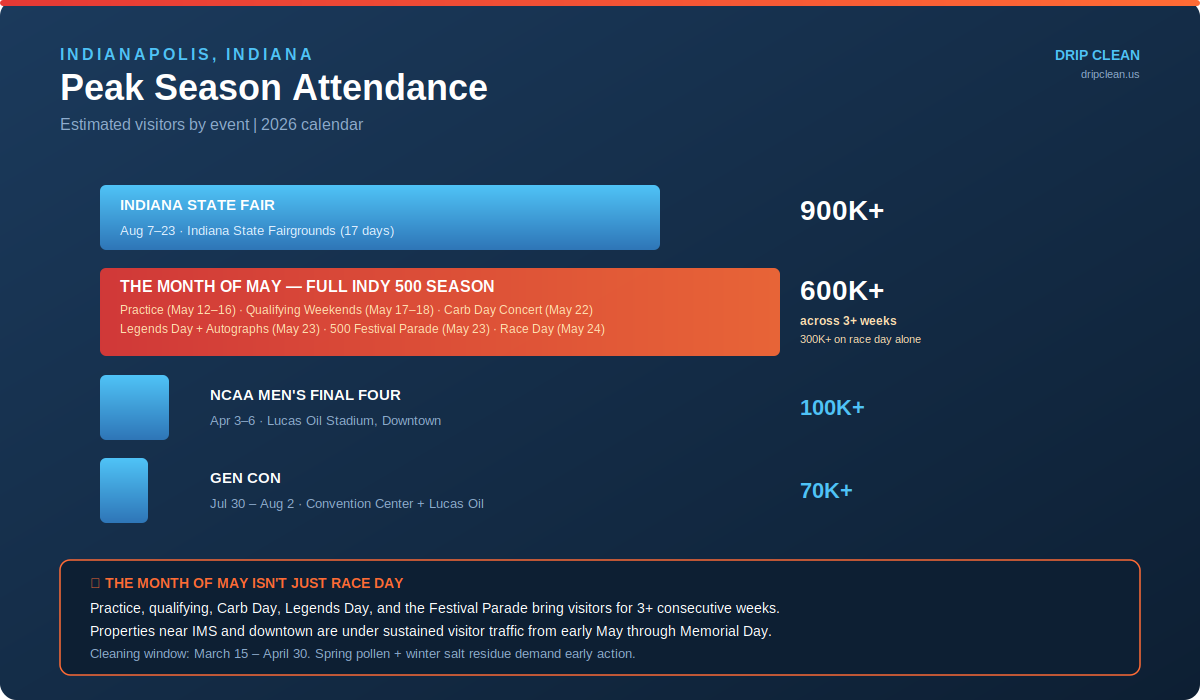
Indianapolis peak season attendance by event | 2026
Cincinnati sees Taste of Cincinnati draw 500,000 over Memorial Day weekend, followed by the Cincinnati Music Festival in late July. But the real crescendo comes in September and October: Oktoberfest Zinzinnati celebrates its 50th anniversary September 17–20 with an expected 800,000 attendees, and just three weeks later, BLINK — the nation’s largest light art and projection mapping festival — transforms 30 city blocks into an outdoor art gallery for more than two million visitors.
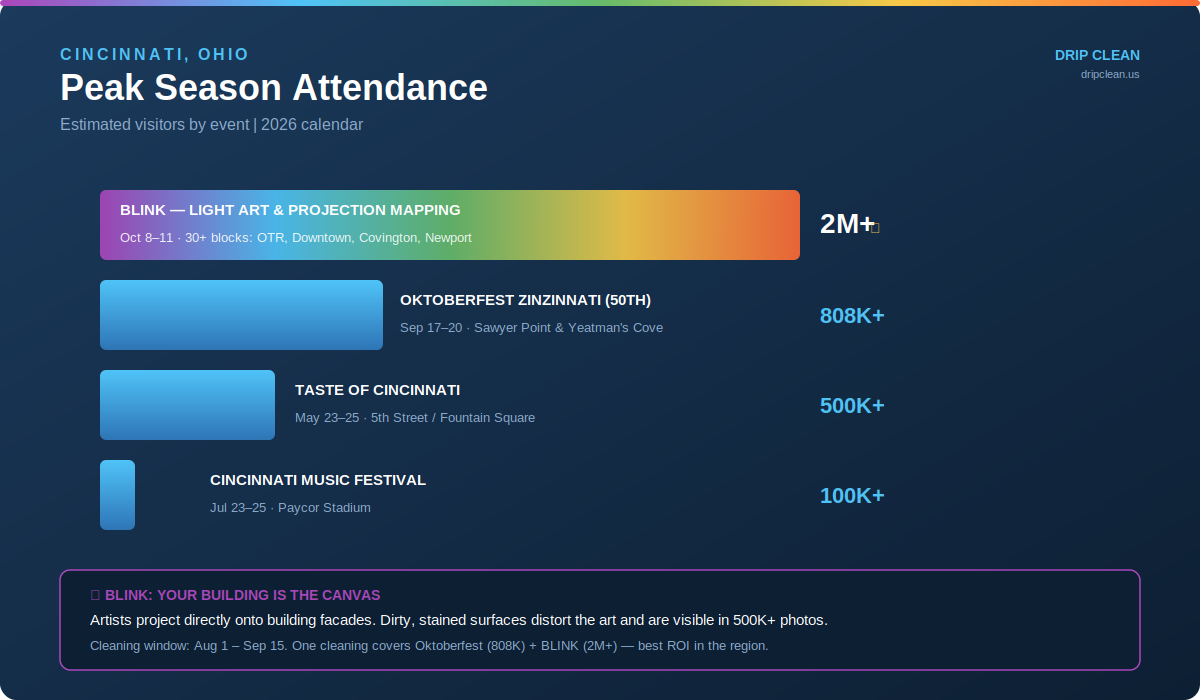
Cincinnati peak season attendance by event | 2026
Lexington opens Keeneland’s Spring Meet on April 3, debuting a brand-new $100 million Paddock Building alongside 15 days of premier thoroughbred racing. The Railbird Music Festival brings 40,000 fans to Red Mile in June, UK Football’s SEC schedule fills 61,000-seat Kroger Field every Saturday in the fall, and the Breeders’ Cup World Championships return to Keeneland October 30–31 with international media and horse racing’s most prestigious visitors.
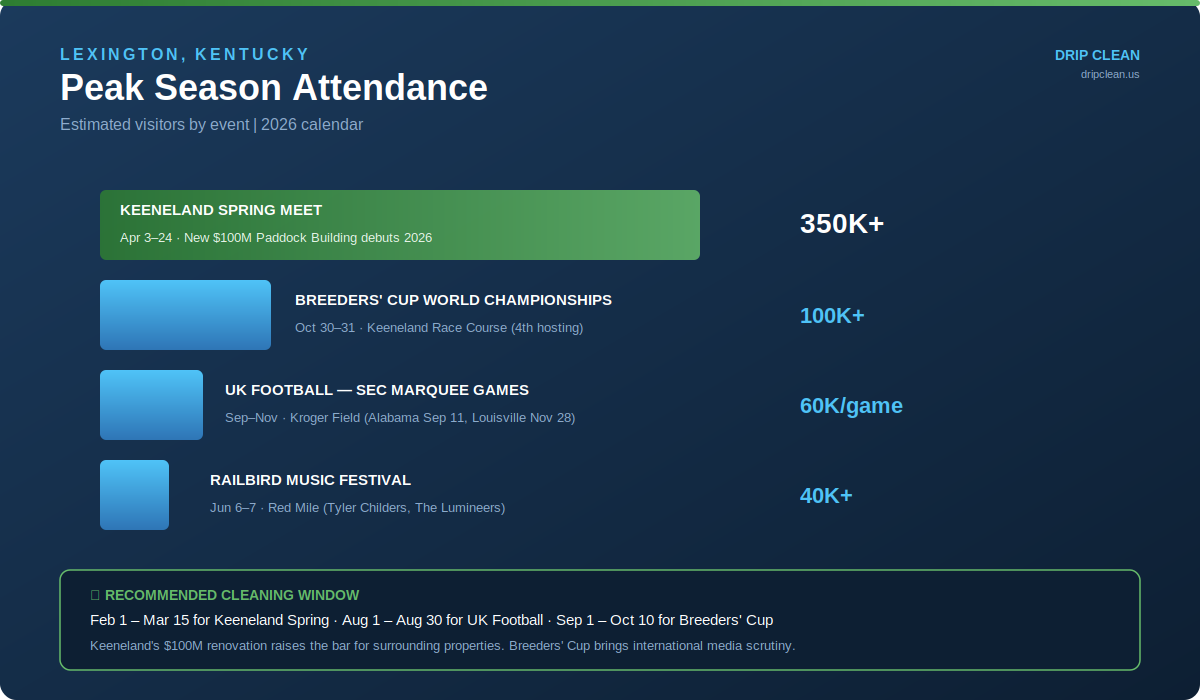
Lexington peak season attendance by event | 2026
The Facility Manager’s Responsibility
Every one of these events creates a concentrated surge of foot traffic, photography, social media exposure, and in the case of BLINK, literal projections onto building facades. For facility managers, the stakes are straightforward but significant.
A building’s exterior is the first thing visitors, tenants, and prospective clients see. Algae streaks on a hotel facade during Derby Week don’t just look bad — they show up in guest photos, Google reviews, and social media posts seen by thousands. Pollen-covered limestone on a downtown office building during Final Four weekend signals neglect to every corporate tenant walking through the lobby. A parking garage with years of grime buildup across from the Oktoberfest grounds tells 800,000 people that nobody’s paying attention.
Building exteriors deteriorate predictably with the seasons. Winter leaves behind road salt residue and grime. Spring coats light-colored stone and concrete in pollen. Summer’s heat and humidity accelerate algae and mold growth on north-facing walls. Fall brings leaf staining and organic debris. Each season layers on the last, and by the time a major event arrives, the cumulative effect is visible from the street.
The responsibility falls to facility managers and property managers to plan ahead — not just for the event itself, but for the seasonal maintenance window that precedes it. A building cleaned six to eight weeks before a major event will look fresh through the entire peak season. A building cleaned the week before will still be drying when the first visitors arrive.
A Better Approach for Buildings That Can’t Afford Downtime
The challenge with traditional exterior cleaning has always been logistics. Scaffolding takes days to erect and requires permits, lane closures, and coordination with tenants. Boom lifts block parking lots and sidewalks. Swing stages limit cleaning to one wall section at a time. For a hotel at 95% occupancy during Derby Week or a convention center hosting 70,000 attendees, shutting down access to erect scaffolding simply isn’t an option.
This is where drone-powered exterior cleaning is changing the conversation for commercial and industrial properties.
Purpose-built cleaning drones operate from ground level with no scaffolding, no lifts, and no disruption to building access or daily operations. A drone can clean building exteriors up to 150 feet — or higher — reaching facades, soffits, signage, and upper-story windows that traditional methods struggle to access efficiently. Because the equipment launches and operates from the ground, there are no lane closures, no parking lot shutdowns, and no tenant complaints about blocked entrances or equipment noise.
The operational benefits for facility managers are measurable. Project timelines compress by 40 to 60 percent compared to traditional scaffolding-based approaches. Setup time drops from days to hours. Safety risk is dramatically reduced because workers stay at ground level rather than operating at height. And because the drone can access the full building envelope in a single mobilization, you get comprehensive coverage rather than the piecemeal, section-by-section approach that scaffolding forces.
For properties in high-traffic event zones — a downtown hotel on Louisville’s Whiskey Row, an office tower on Indianapolis’s Capitol Avenue, a mixed-use building on Cincinnati’s Vine Street, or a parking garage on Lexington’s Versailles Road — the ability to clean quickly, safely, and without operational disruption isn’t just a convenience. It’s the only practical option during peak season.
A Special Note for Cincinnati Building Owners: BLINK 2026
BLINK deserves its own mention because it flips the script entirely. During most events, buildings are the backdrop. During BLINK, buildings are the canvas. Artists project large-scale light installations directly onto building facades across 30 blocks of downtown Cincinnati, Over-the-Rhine, and Northern Kentucky. If a facade is stained, streaked, or discolored, it doesn’t just look bad — it distorts the art. Building owners in the BLINK corridor have a direct incentive to ensure their exteriors are clean, even, and projection-ready. The cleaning window between Oktoberfest (September 17–20) and BLINK (October 8–11) is tight, which makes planning ahead essential.
Plan Now, Not Later
The events on the 2026 calendar are already set. The dates are locked. The visitors are coming. The only variable is whether your building will be ready for them.
The most effective facility managers are the ones who plan exterior maintenance around their market’s event calendar rather than reacting to it. That means identifying your cleaning window — typically six to eight weeks before a major event — and scheduling work before demand peaks and vendor availability tightens.
For Louisville properties, that window is February through March. For Indianapolis, it’s March through April. For Cincinnati, it’s August through mid-September. For Lexington, the spring window opens in February, and the fall window runs through September and early October.
The buildings that look their best during peak season aren’t the ones with the biggest maintenance budgets. They’re the ones with the best planning. Start the conversation with your cleaning partners now, lock in your dates, and make sure your property is ready for its moment in the spotlight.
DRIP Clean LLC specializes in drone-powered exterior cleaning for commercial and industrial buildings across Kentucky, Indiana, Ohio, and Tennessee. To schedule a free site assessment or learn how drone cleaning can fit your maintenance calendar, visit www.dripclean.us or call 317.522.6226.
